Accounting Practice Questions and Study Resources


Accounting problems can feel tricky when you’re not sure which rule to use. These accounting practice questions cover core topics, show how to work through sample answers, and point you to ways to practice from your own course materials.
An analysis of 40 comments and questions from YouTube, Reddit and Quora about accounting practice questions found that 20% mentioned detailed explanations and solutions.
Accounting Practice Questions by Topic
Start with the topic your class is working on. A question about a journal entry tests a different skill than one about inventory or the cash flow statement. Mixing topics too soon can make it hard to tell which rule you need to review.
Use this topic map to pick a useful first set:
- Accounting basics: the accounting equation, normal account balances, and debits and credits.
- Journal entries and accruals: sales on account, prepaid costs, unearned revenue, and adjusting entries.
- Financial statements: the income statement, balance sheet, cash flows, and common ratios.
- Inventory and long-term assets: inventory errors, cost methods, depreciation, and asset sales.
- Management accounting: variable costs, break-even sales, budgets, and variance analysis.
- Auditing and controls: audit evidence, internal controls, and audit opinions.
If you’re in an introductory course, start with the accounting equation, journal entries, and adjusting entries. Those ideas show up in later topics, so it helps to know what each entry changes. If you’re preparing for the CPA exam, add financial reporting, audit topics, and the sections named in your current exam outline.
A good set has more than definition checks. Try a mix of questions that ask you to name an account, record a transaction, or explain its effect on a financial statement. The practice question generator guide explains how to build questions from course files when you need more topic-specific practice.
For a quick self-check, ask what changed in assets, liabilities, equity, revenue, or expenses. If you can explain the change, you’re learning the rule behind the answer, not only its wording.

Worked Accounting Questions With Answer Explanations
Try each question before reading the explanation. That pause matters: it shows whether you can recall the rule and apply it, rather than simply recognize a familiar answer.
1. Accounting equation
Question: A company has assets and liabilities. What is its equity?
Answer: Equity equals assets minus liabilities. The accounting equation is assets = liabilities + equity. Check the result by adding liabilities and equity. They must equal total assets.
2. Prepaid insurance
Question: On January 1, a company prepays a one-year insurance policy. What adjusting entry records the three months used by March 31?
Answer: Debit Insurance Expense and credit Prepaid Insurance for the portion used. The policy covers one year, and three months have passed, so that portion has become an expense. The rest stays in the asset account because it covers future months.
3. Sale on account
Question: A company earns revenue from a sale on account. What entry records the sale?
Answer: Debit Accounts Receivable and credit Sales Revenue for the amount of the sale. The customer owes the company, so receivables rise. The company has earned revenue, even though cash hasn’t arrived yet. If the problem also gives the cost of the goods, check whether it asks for a second entry to record Cost of Goods Sold and reduce Inventory.
For a missed answer, don’t stop at “I used the wrong account.” Name the rule you missed. Was it cash versus credit? An asset versus an expense? The active recall study steps can help you turn a missed question into a prompt you can test again later.
Worked examples can also reveal what an answer explanation should do. It should show the rule, connect the numbers to the rule, and explain why the wrong idea fails.
When reviewing any answer key, compare the logic with your assigned notes, especially if your instructor uses a specific method or convention.
Try a similar question with new numbers after you understand the first solution. If you can still explain each step, you’re more likely to recall the process when the wording changes.
Online Accounting Question Banks and CPA Practice
Online question banks can help when you need a steady supply of exam-style questions. But the right choice depends on what you’re studying. A CPA candidate may need practice mapped to exam sections, while a student in an accounting class may need questions based on this week’s lecture slides.
Here’s a quick comparison of a few options:
Turn your notes into a practice exam
Upload a document and StudyBuddy builds questions, flashcards and explanations in minutes.
Try it free| Resource | Useful for | Practice or access details |
|---|---|---|
| StudyBuddy | Questions made from your own course files | Turns uploaded materials into MCQs, flashcards, and answer explanations. Browser guest sessions are available without signup; Pro costs $8.99 per month or $89.90 per year. |
| OpenExamPrep | Free exam-style practice across finance and other certification areas | Its practice bank is free to use, with 10 AI interactions daily. |
| CPA FAR Practice Test 2026 | A short FAR-specific trial set | Try 30 questions free. |
| UWorld’s CPA QBank | CPA review and repeated exam practice | Includes exam-matched questions, task-based simulations, practice tests, and SmartPath analytics. |
StudyBuddy is useful when your course materials are the main source you need to study. Upload a PDF, lecture slides, notes, photos, or a YouTube video. The app turns that material into MCQs, flashcards, and answer explanations, then adapts practice to your performance. Topic mastery and Readiness Score help you choose what to review next; they’re study signals, not a promise of an exam result.
OpenExamPrep is a free option for broad exam practice. It includes 10 free AI interactions daily. The CPA FAR Practice Test gives you a smaller, focused trial set. Those can work well when you want to sample a question style or add a short session without building a quiz from your own files.
For CPA review, UWorld’s CPA QBank includes SmartPath analytics that track attempts and indicate readiness. That kind of progress data can help you decide whether to revisit a topic or continue to the next section. Still, check your current exam outline and course plan before treating any question bank as a full study plan.
Use the bank that fits the next task. Need to check a lecture? Use questions tied to that material. Need exam-format practice? Pick a bank built for your certification and review its explanations after each set.
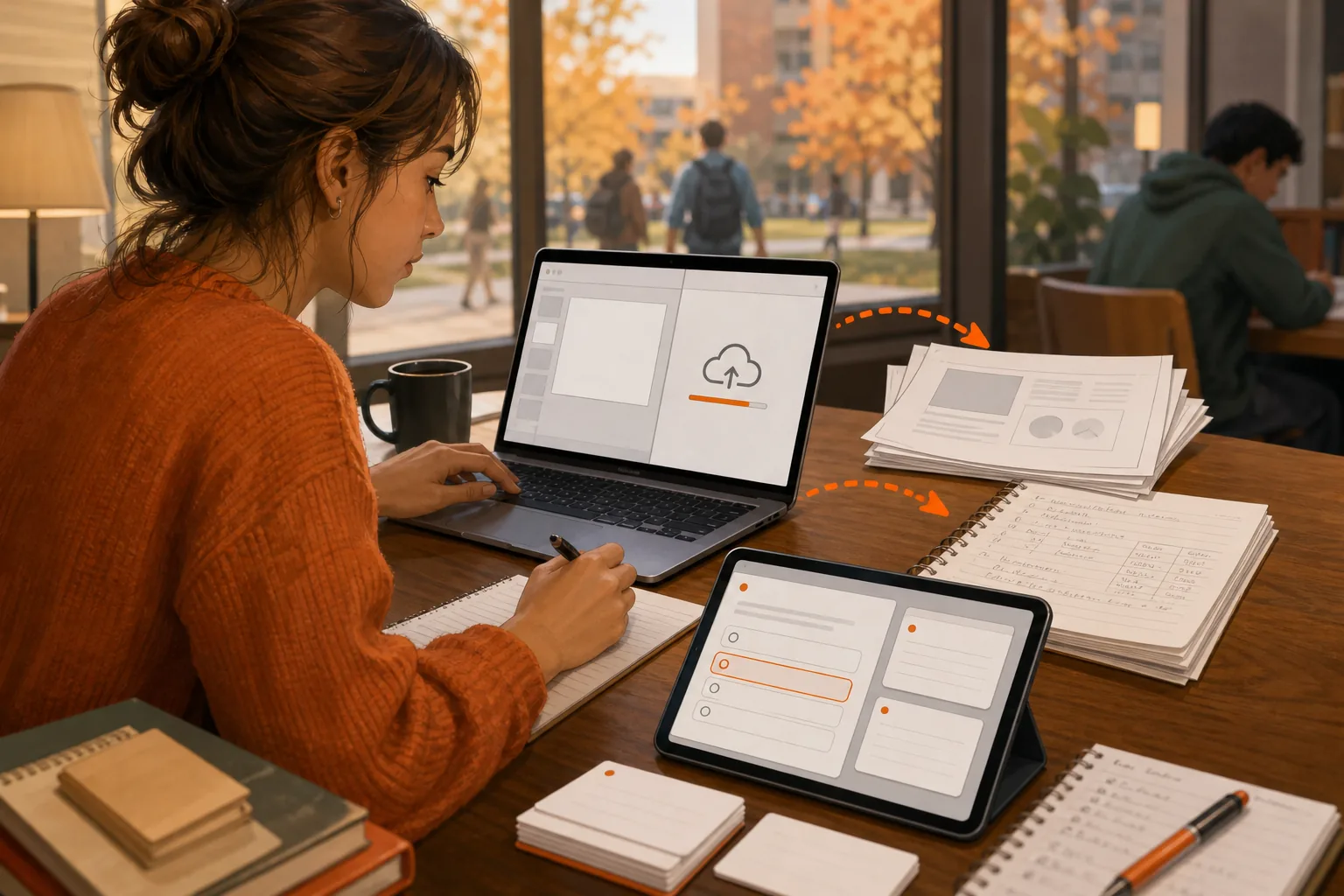
Make Practice Questions From Your Course Materials
A general question bank can test common accounting rules. Your class may go deeper on a particular chapter, use a certain method, or stress terms from the professor’s slides. Building practice from your own materials can keep review close to what you’re expected to know.
Begin with one unit, not your whole course folder. Gather the matching lecture slides, course PDF, notes, textbook pages, or official study guide. Keep materials for other subjects out of the same set so questions stay focused.
Then turn each learning point into a question that asks you to do something. For example, a slide about depreciation might prompt you to calculate an adjustment. A note on internal controls might ask you to identify a preventive control. A section on inventory might ask what happens to net income when ending inventory is overstated.
StudyBuddy can turn uploaded course files into multiple-choice questions, flashcards, and answer explanations. Adaptive Study changes later practice based on how you answer, while topic mastery and Readiness Score help you spot what may need another look. You can try browser guest sessions without signup; paid access is separate, and free use isn’t unlimited.
For a simple workflow, upload one unit, answer a short set, then check each explanation against the original file. If an answer seems wrong or too broad, use your class source as the final check. AI-generated practice is a starting point, not a replacement for the wording in an assigned text or official guide.
A study-planning guide is another reference to keep alongside your course materials. The useful habit is to connect each practice session to a clear goal: review one chapter, test one rule, or revisit questions you missed.
After the first set, sort mistakes by topic. If you missed several questions about accruals, go back to that section before doing another mixed quiz. Once the basics feel steady, mix related topics so you have to choose the right rule without a heading telling you what to use.
FAQ
What topics should I study first in accounting?
Start with the accounting equation, normal account balances, debits and credits, and basic journal entries. Those ideas support later work on adjusting entries and financial statements. After that, focus on the topics in your class or exam outline. If you keep missing one kind of problem, pause mixed practice and review that topic on its own.
How do I get better at accounting multiple-choice questions?
Try to solve each question before looking at the choices or answer explanation. Write down the rule you’re using, then check whether the numbers and account names fit. When you miss one, explain why your choice was wrong. Repeat a similar question with different figures to see if you can apply the rule again.
Are free accounting question banks enough for CPA study?
Free question banks can help you review topics and test your recall, but you should match your study plan to the current CPA exam outline. Check what each resource covers and whether its questions fit the exam section you’re preparing for. Use explanations to find gaps, then study those areas with material that matches your course or review plan.
Can I make accounting quizzes from my lecture slides?
Yes. A study app such as StudyBuddy can turn uploaded lecture slides, PDFs, notes, photos, or videos into MCQs, flashcards, and answer explanations. Check the generated answers against your original course material, especially when a small wording detail changes the accounting treatment. Then use missed questions to pick the next topic to review.
Conclusion
Pick one topic you’re studying now and solve a small set before checking the answers. If your class notes are the best source, use StudyBuddy to turn one unit into practice, then review any explanation against the original material.
Turn your notes into a practice exam
Upload a document and StudyBuddy builds questions, flashcards and explanations in minutes.
Try it freeRelated articles
-
How to Do Spaced Repetition: A Step-by-Step Guide
Studying the same material for hours can feel productive, then leave you unsure what you can recall. Learning how to do spaced repetition gives each topic another chance to stick: review it after a...
-
How to Study for a Final Exam: 5 Steps That Work
If you’re figuring out how to study for a final exam, a pile of slides and notes can make it hard to know where to begin. Start with the topics your instructor is likely to test, then spend most of...
-
Best Personalized Learning Apps for Students
A personalized learning app can make your course materials easier to study, but the apps don't all adapt in the same way. Some build practice from your files; others guide you through set lessons...