Who is at risk?
See who has never practiced, who stopped, who is struggling with several topics and who has barely practiced. One click sends them a reminder.
For professors and universities
Upload the material you already teach with. Your students practice with questions built from it, on their phone or computer. You see, by name, who is falling behind and which topic to teach again.
Free for one exam period. Nothing to install.
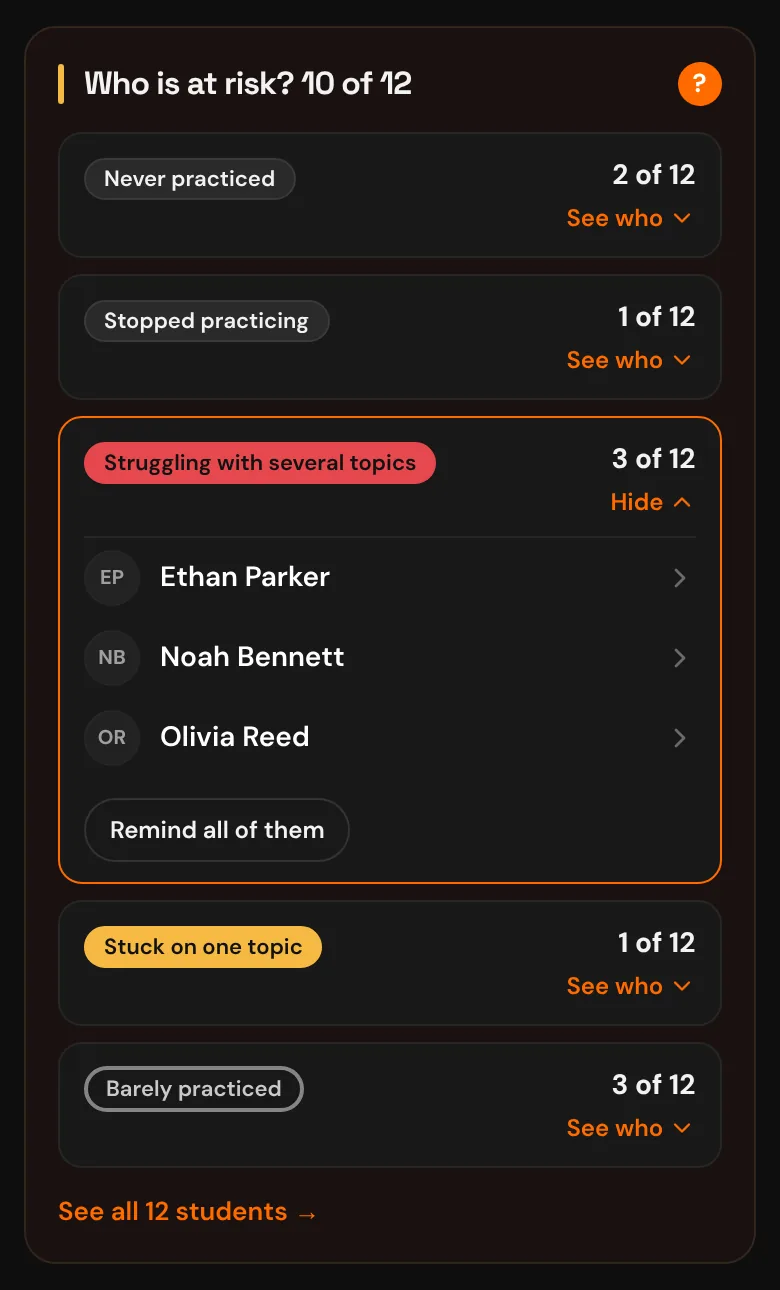
Between one exam and the next, there's no way to know who is studying, who stopped, or which topic the class got stuck on.
Writing questions with believable wrong answers and an explanation for each one takes hours. That's why there's rarely anything to practice with.
You review everything equally because you can't tell which topic they already understand and which one needs another explanation.
What you see
Open your group's progress whenever you want. It answers three questions with names and head counts, never with averages that hide who.
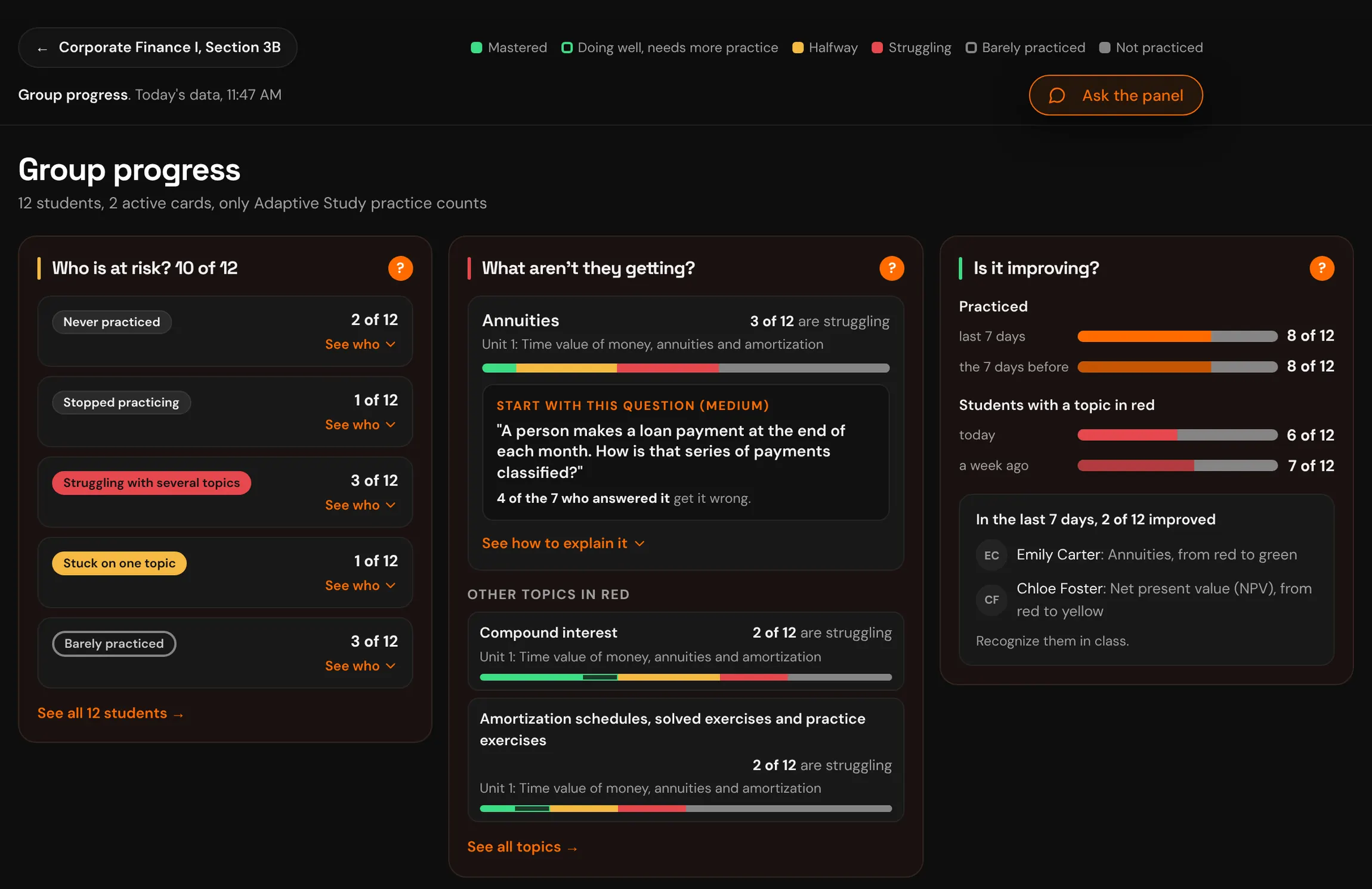
See who has never practiced, who stopped, who is struggling with several topics and who has barely practiced. One click sends them a reminder.
The topics they struggle with most, in order, with the question to open class with. When one topic depends on another, it tells you which to review first.
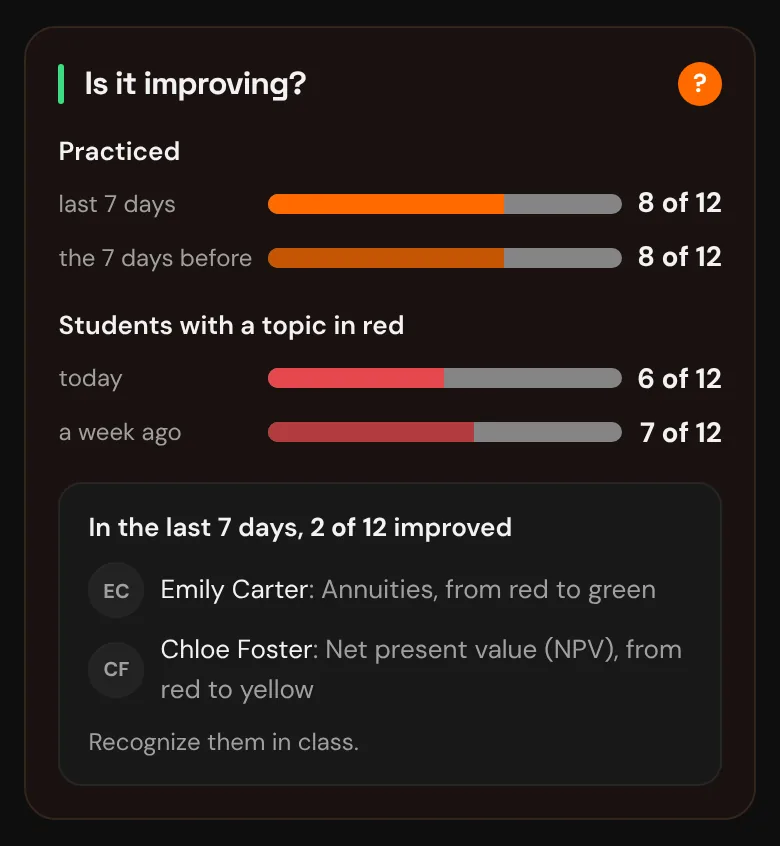
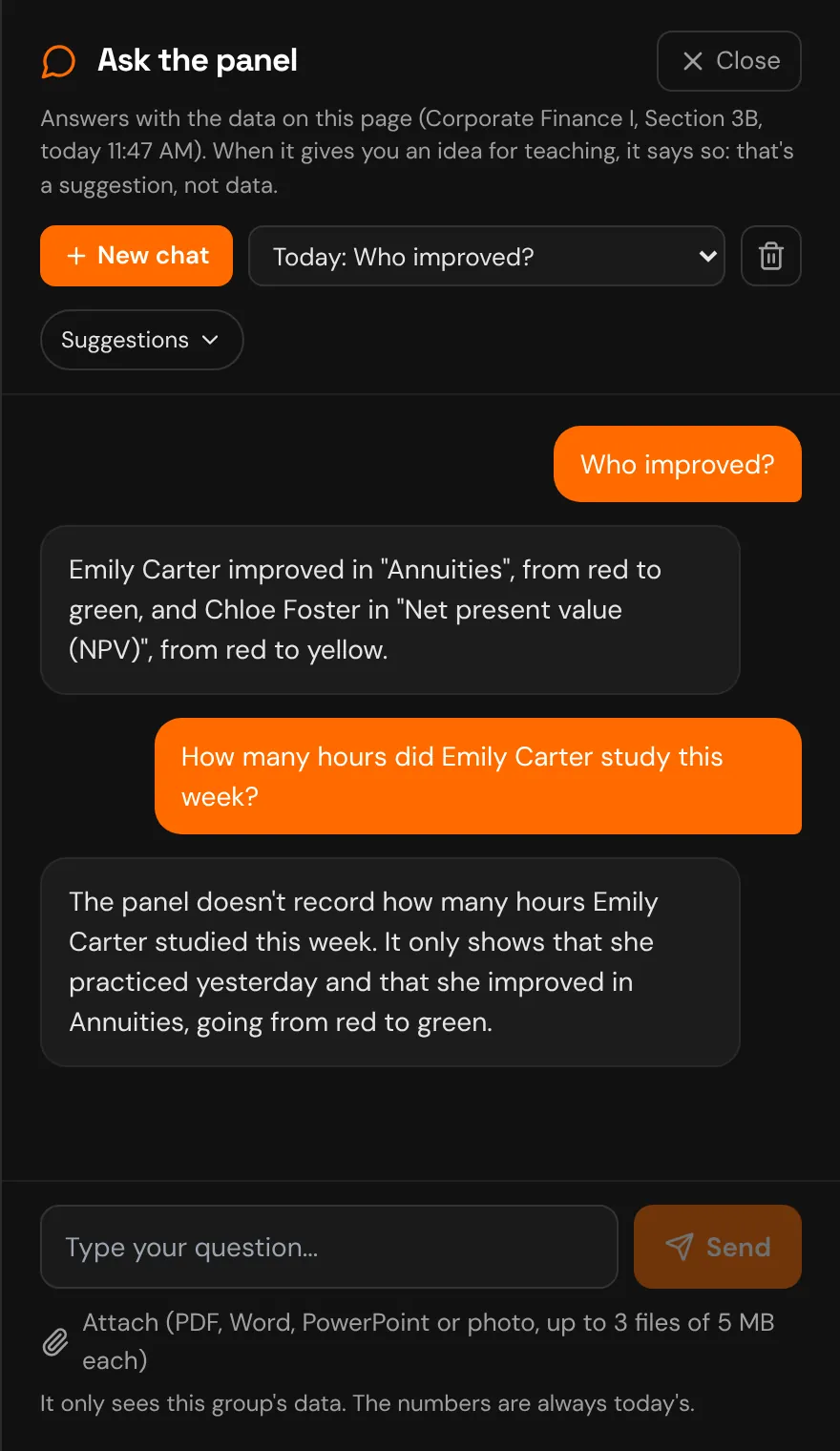
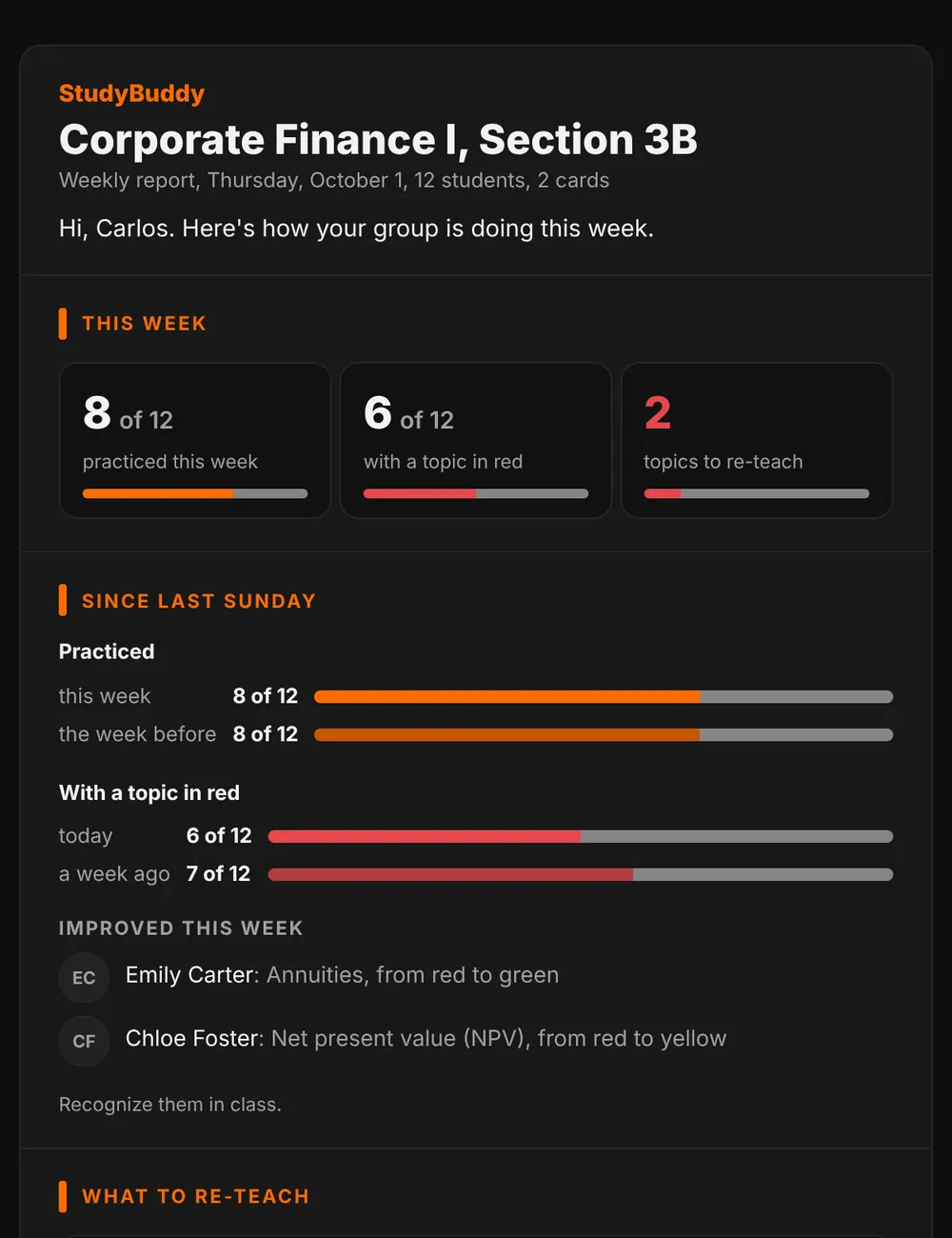
Compare the last 7 days with the 7 before: how many practiced, how many have a topic in red, and who improved, by name, so you can recognize them in class.
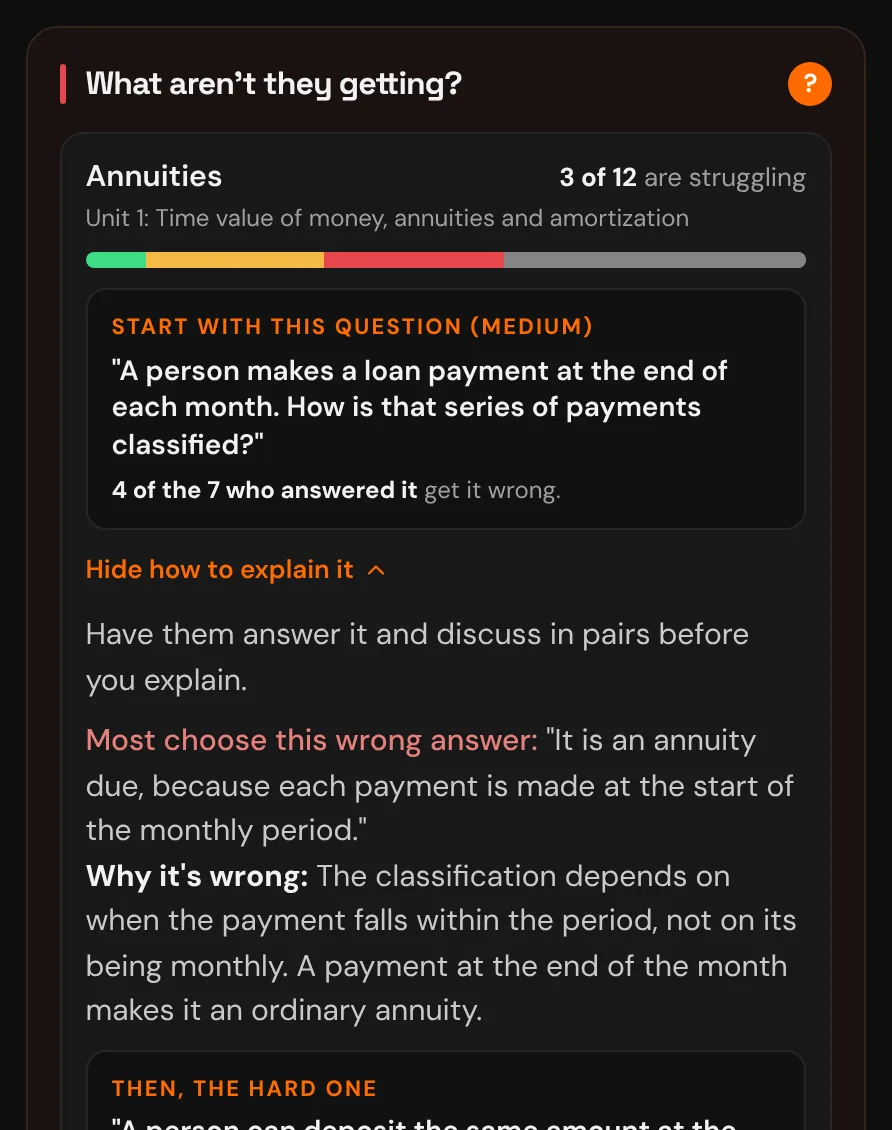
For every topic they struggle with, the panel shows the wrong answer most students choose and why it's wrong. You walk into class knowing which confusion to clear up.
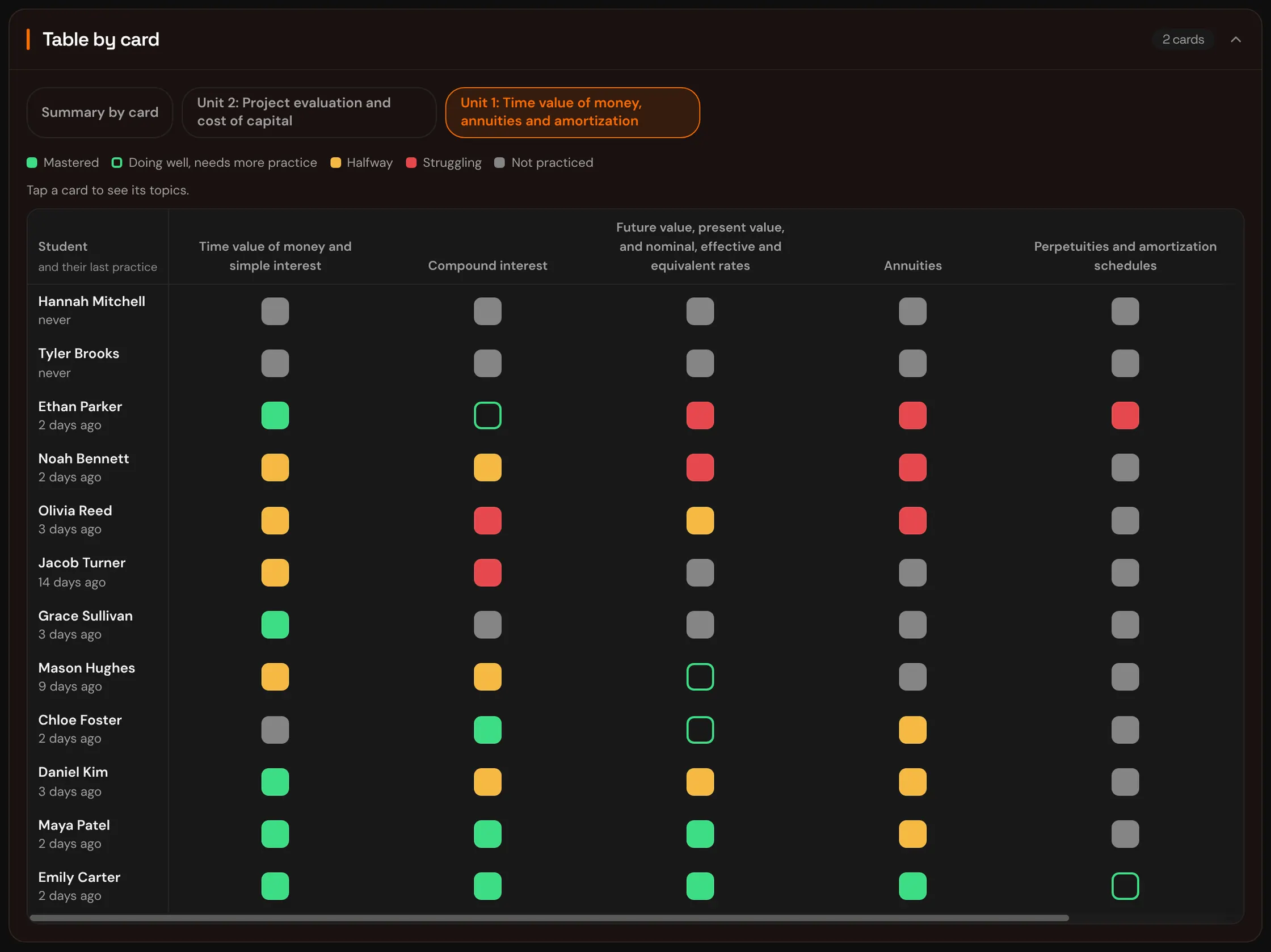
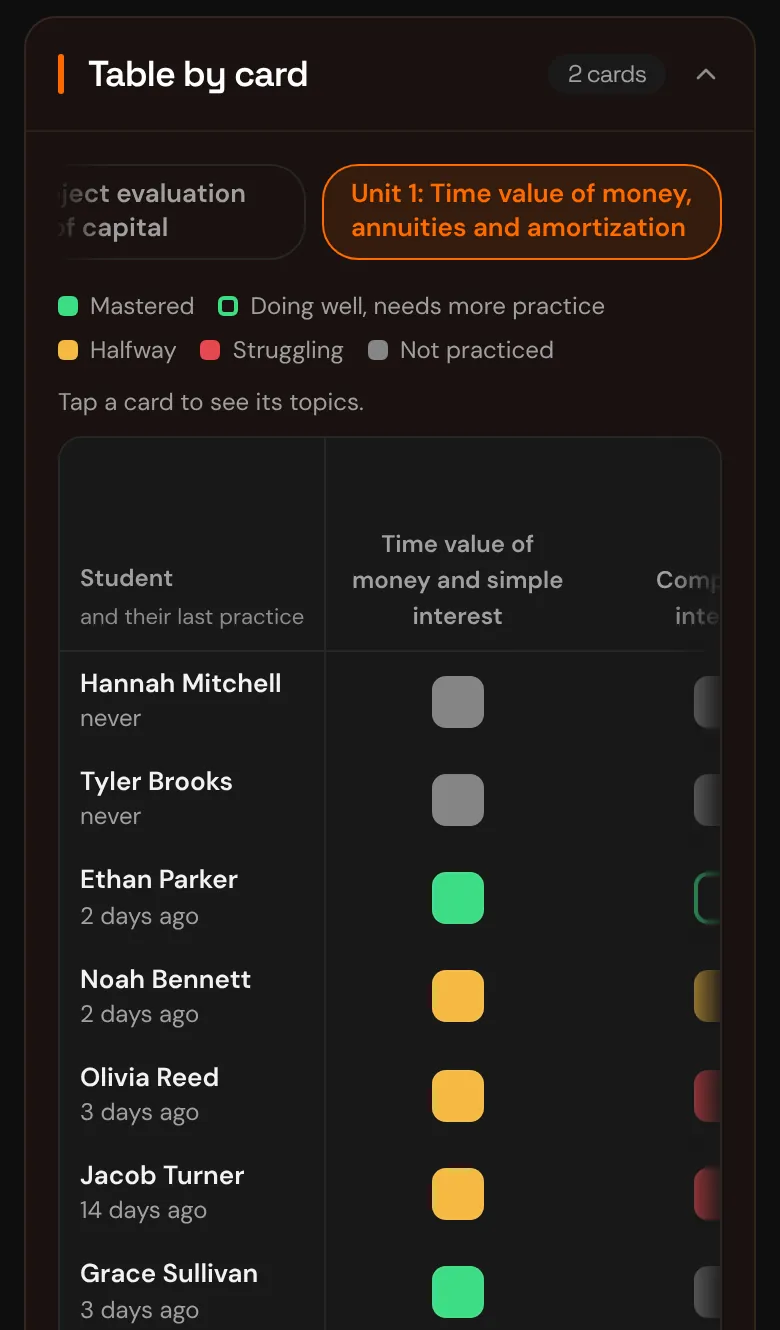
Every student against every topic, in color: mastered, doing well, halfway, struggling or not practiced.
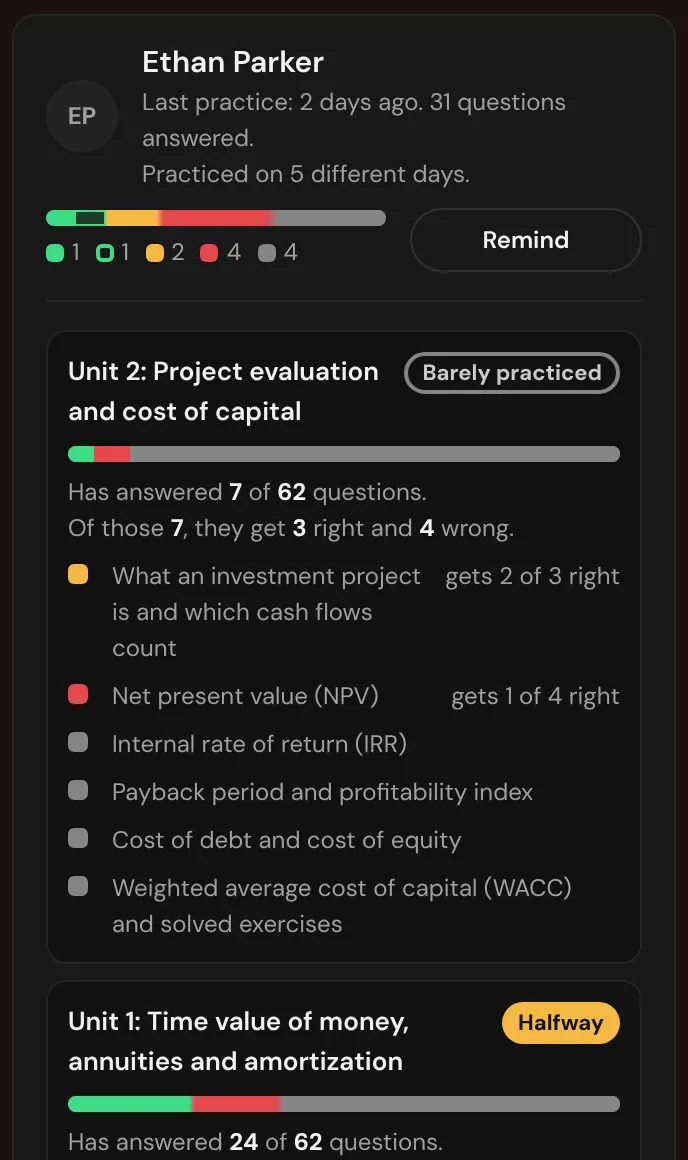
Open any student: how many questions they've answered, which ones they get right and when they last practiced.
Type your question the way you'd ask a colleague. It answers with your group's data and, when it doesn't have the data, it says so.
A summary of the week: how many practiced, who improved and what to teach again.
What your students get
They come from the material you uploaded and published, not from a generic question bank online.
When they miss, they see right away why their answer is wrong and which one was right.
Adaptive Study asks more about what they struggle with and less about what they've already mastered.
They join with a link and practice from the browser on their phone or computer. Your group's material costs them nothing.
A person makes a loan payment at the end of each month. How is that series of payments classified?
Incorrect
The classification depends on when the payment falls within the period, not on its being monthly. A payment at the end of the month makes it an ordinary annuity.
Adaptive Study
This is how your students practice. Adaptive Study keeps track of how each student is doing on each topic of your material, and uses that to choose what to ask next.
How often each topic comes up
The topics a student misses come up more often. The ones they've mastered come up less, but keep coming so they aren't forgotten.
How much they remember of a topic
An illustration of the calculation, not data from a class.
It estimates how much a student remembers of each topic from when they practiced it and how it went. When they come back to study, what is fading gets priority.
The difficulty of the questions
AnnuitiesEach topic starts with mostly easy questions. As the student gets them right, harder ones come up, and after a miss they ease off a little. So they don't get stuck on the hard ones or stay on the easy ones.
Why each question comes up
It doesn't ask topics in blocks or in just any order: it alternates them based on how the student is doing in each one, and comes back sooner to the ones they struggle with most. Within each topic, it first asks what they haven't seen.
Because that's where students practice topic by topic and see the explanation right away. Every answer updates how they're doing on that topic, and that's what builds what you see: who is at risk, which topic is hard and who improved.
Practice with instant explanations. It's the only thing that moves your panel.
A timed exam with random questions. Your students can use it to rehearse; the result doesn't move your panel.
Their personal documents don't count and don't show up in your panel.
And for a topic to show as "Mastered", getting everything right in one afternoon isn't enough: the student has to get it right on different days.
Practicing with questions and spreading study over several days are the two study techniques that research rates highest. Adaptive Study is built around both.
What the research says
We won't promise you a grade. What we can show you is what has been measured when students practice with questions instead of only rereading their notes.
One week later
Of every 100 ideas in a text, those who tested themselves recalled 56 and those who only reread it recalled 42.
University students, in a lab. After 5 minutes, those who reread remembered more; a week later it had reversed. Roediger and Karpicke, 2006.
In a real course
On the course exam, the same students got 84 of every 100 questions right on the concepts they had practiced with questions on different days, and 72 of every 100 on the ones they studied as usual.
An Introductory Psychology course, 79 students. A second experiment found a smaller gain. Rawson, Dunlosky and Sciartelli, 2013.
Fewer failing students
Of every 100 students, about 34 failed or dropped the course with lecture-only classes, and about 22 did when they also worked on questions and exercises in class.
An analysis of 225 studies in science, engineering and math (failure rates, in 67 of them). It measures active work during class. Freeman and colleagues, 2014.
Which techniques work
Of 10 study techniques reviewed, only 2 were rated high utility: practice testing and spreading practice over time. Highlighting and rereading were rated low.
Dunlosky and colleagues, 2013.
And a review of 222 studies in real classrooms, with 48,478 students, found that class quizzing raises academic achievement to a medium extent (Yang and colleagues, 2021).
These results come from published research on the method (practicing with questions and spreading study over time), not on StudyBuddy, and they don't guarantee a grade. What happens in your class is what we measure together during the trial.
How it works
Your PDFs, slides and Word documents, a recording of your class, or a YouTube video.
StudyBuddy finds the topics and proposes questions for each one. You approve, edit or discard. You can also download them to Word.
Choose which topics go in and until what date. Your students join with a link or a code.
Open the progress page whenever you want, or wait for Sunday's summary in your inbox.
You decide
StudyBuddy gives you information about your class. What to do with it is up to you.
Using the Rule of 72, about how long does it take to double an amount at 8% compounded annually?
A person deposits $200,000 at 9% compounded annually for 3 years. What is its future value?
What is the usual timing pattern of the working capital a project requires?
Topic fully reviewed.
No question reaches your students until you publish. Before that, you can review them one by one, edit them or discard them.
Practice states, not grades.
It doesn't give grades or decide who passes. It shows you who has practiced and which topics are hard.
Are they ready for the exam?
The call is yours
It shows you your group's data and the call is yours.
It says "3 of 12 students" and shows you who they are. An average doesn't tell you who to help.
For department heads and deans
What a department usually asks before saying yes.
It runs in the browser. Nothing to install and nothing to connect to other systems.
Publish to your students
Expires (optional)October 7, 2026
PublishPublishedEach professor decides what material goes in and which questions students see.
The professor sees
Doesn't see
To join, a student creates a free account with their name and email. The professor sees their name, email and progress on the group's material. The professor does not see their personal documents or what they study on their own. Privacy Policy.
Not for the institution, the professor or the students.
The free trial
We're opening the free trial to a small number of groups, 4 to 6 weeks long, to try it in a real class.
You can create your group, upload your first document and publish your first topic the same day. What does take time, and is worth it, is reviewing the questions before you publish them.
PDF, Word, PowerPoint and text files; class recordings in audio or video (up to about 3 hours); and YouTube videos that have captions.
It isn't required, but it's worth it. You can approve them one by one, edit them, discard them, or approve all the questions of a topic at once. When you publish a topic, anything you haven't reviewed goes out as is and anything you discarded stays out. Nothing reaches your students until you publish it.
No. They create a free account and join with your link from the browser on their phone or computer. Practicing with your group's material costs them nothing.
No. It's practice, not an exam. It doesn't give grades or decide who passes: it shows you who has practiced and which topics are hard, and you decide what to do.
The platform is in Spanish and English, and questions come out in the language of your material.
Each student creates an account with their name and email. You see their name, email and progress on your group's material. You don't see their personal documents or what they study on their own. They can leave the group whenever they want. The details are in the Privacy Policy.
There's no list price for professors or institutions yet. If you want to continue when it ends, we'll talk about it with your group's data in hand.
Start here
Tell us about your class and we'll write to get you started. We reply within one or two business days.
Prefer to write to us directly?
We'll write to the email you left within one or two business days.